




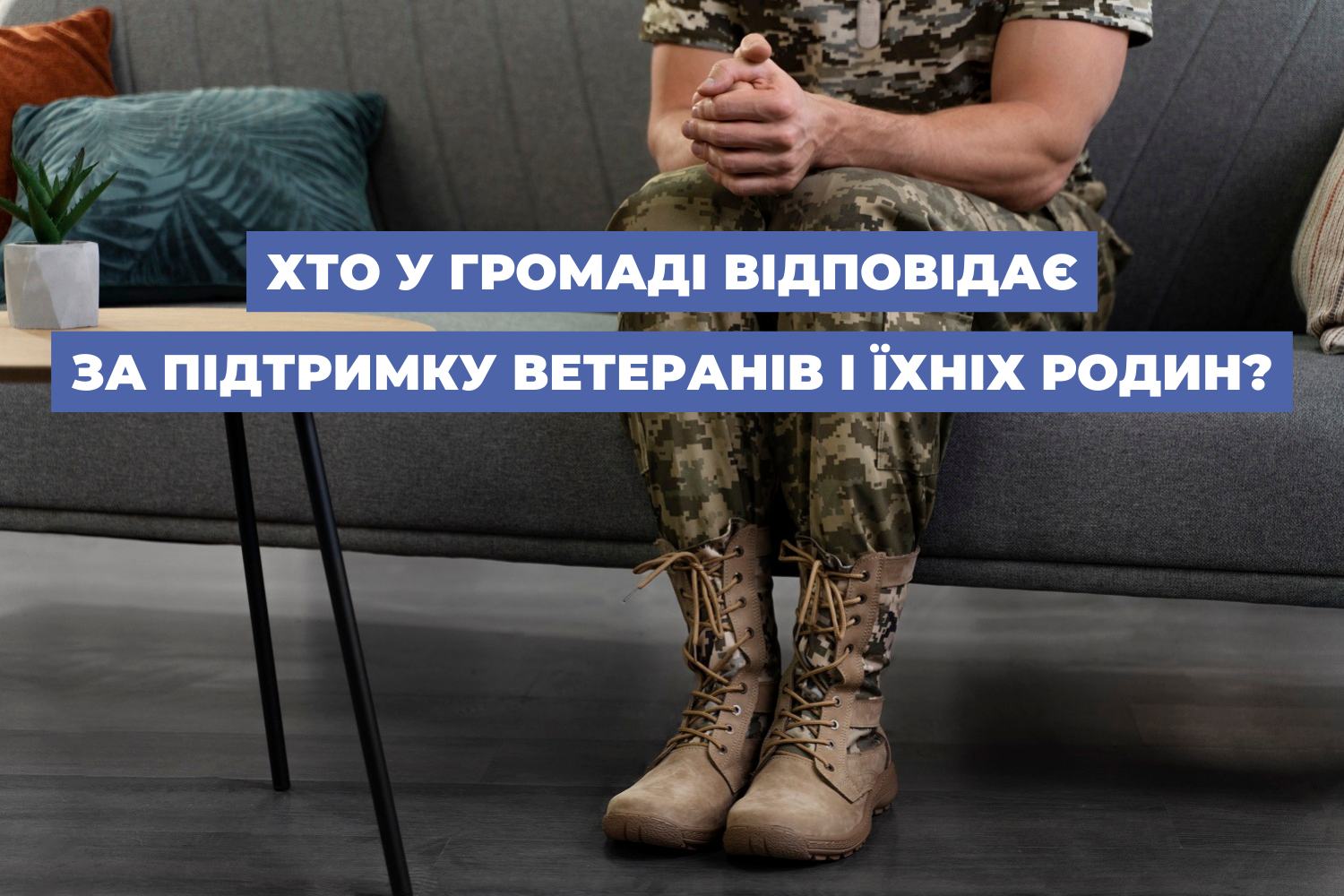
The info session “Interagency and Interprofessional Cooperation in Support of War Veterans and Their Families in the Municipality” was held on June 19, featuring U-LEAD experts Liudmyla Pona and Liudmyla Berezovska as the speakers.
Oksana Shvets, Adviser on Municipal Finance and Management at the Regional Office of U-LEAD with Europe in the Ivano-Frankivsk Oblast and moderator of the event, explained the importance of the issue:
“Instead of just any one given issue, veterans and their families often face a host of problems that include physical, psychological, economic and social aspects. Therefore, rehabilitation and re-integration of veterans into society require a comprehensive approach, which involves the cooperation of departments and their coordinated efforts.”
The info session provided expert advice and recommendations on developing a municipal veteran policy, and the participants analysed the extent of their interaction with veterans and their families and saw shortcomings and challenges in their activities.
“Throughout the entire educational cycle, we talk about how to develop a veteran’s policy at the municipal level. Every municipality must have systematic teamwork in this direction in place now. Because there will be more challenges in the future and you may struggle to cope,” said Liudmyla Pona.
As she pointed out, cooperation in support of war veterans can be conventionally divided into three levels: interdisciplinary team, interagency and intersectoral cooperation. The latter is about strategic planning in the field of veteran policy, prioritisation of services and their budgeting, as well as development of necessary documents for target programmes. This is the most preferred level.
According to the speaker, veteran policymaking in the municipality requires clarity on the differences between the categories of veterans. It is important to know them and take care of everyone. You need to have answers to the questions, What kinds of support do they need? Which professionals are lacking? Who will be in charge of this? Who will provide financing? A continuous flow of information between different departments and institutions is a must.
At the same time, if the municipality promises something, it must deliver and provide oversight:
“If a family is entitled to appeal to the municipality with a request to allocate funds for the veteran’s treatment, the funds must be provided. If a veteran’s child is entitled to free education, this must be ensured. The same applies if a veteran is entitled to free prosthetics or medicines in pharmacies. And if all this happens within the municipality, the municipality is the one responsible for providing services to meet these needs.”
The expert presented the goals and principles of interagency cooperation in supporting veterans. She listed the following goals:
- Strengthening social cohesion;
- Ensuring and implementing the rights of veterans and their families;
- Provision of services according to the actual needs (instead of their perfunctory imposition);
- Clear procedures and prompt response.
As for principles, it is important to focus on post-traumatic growth, respect for veterans and their families, early work with the family and timely support. Most importantly, the interactions should be centred around veterans and their families.
Next the participants discussed the approaches to building a team of professionals to work with veterans and their families. Liudmyla Berezovska spoke about the main features of the team and explained how to assess its performance:
“Each member of the team has their own resources, skills, and experience and contributes them to the joint effort. Everyone has their own scope of tasks and powers and is responsible for their part of the work. Establish quality and timely communication among team members. The most important advantage of teamwork is the synergy where the combination of different opinions, knowledge and ideas allows for efficiency in accomplishing the tasks.”
A team is necessary to respond to diverse needs. Veteran policy efforts involve systematic work, the involvement of relevant experts and mandatory communication with veterans and their families to determine their needs, problems and requests.
The experts offered a step-by-step procedure for the team to handle veterans’ appeals and explained the don’ts. They also gave advice on ensuring cooperation in support of war veterans and their families:
- Comprehensive assessment of needs and resources;
- Mapping out available services and referral paths;
- Development of local programmes and accounting for the interests of various veteran groups;
- Raising awareness among all first-line practitioners and their training;
- Organisation of experience sharing among municipalities;
- Creation of an interagency team;
- Outreach to veterans and their families;
- Engagement of local municipal clergy in the organisation and provision of assistance.
Finally, the speakers emphasised:
“The municipality is the starting point for the cooperation between the veteran community and the authorities, as war veterans and their families turn to local self-government bodies to solve their problems. So the local self-government should use any leverage and necessary tools available to attract service providers for interagency and interprofessional support of veterans.”