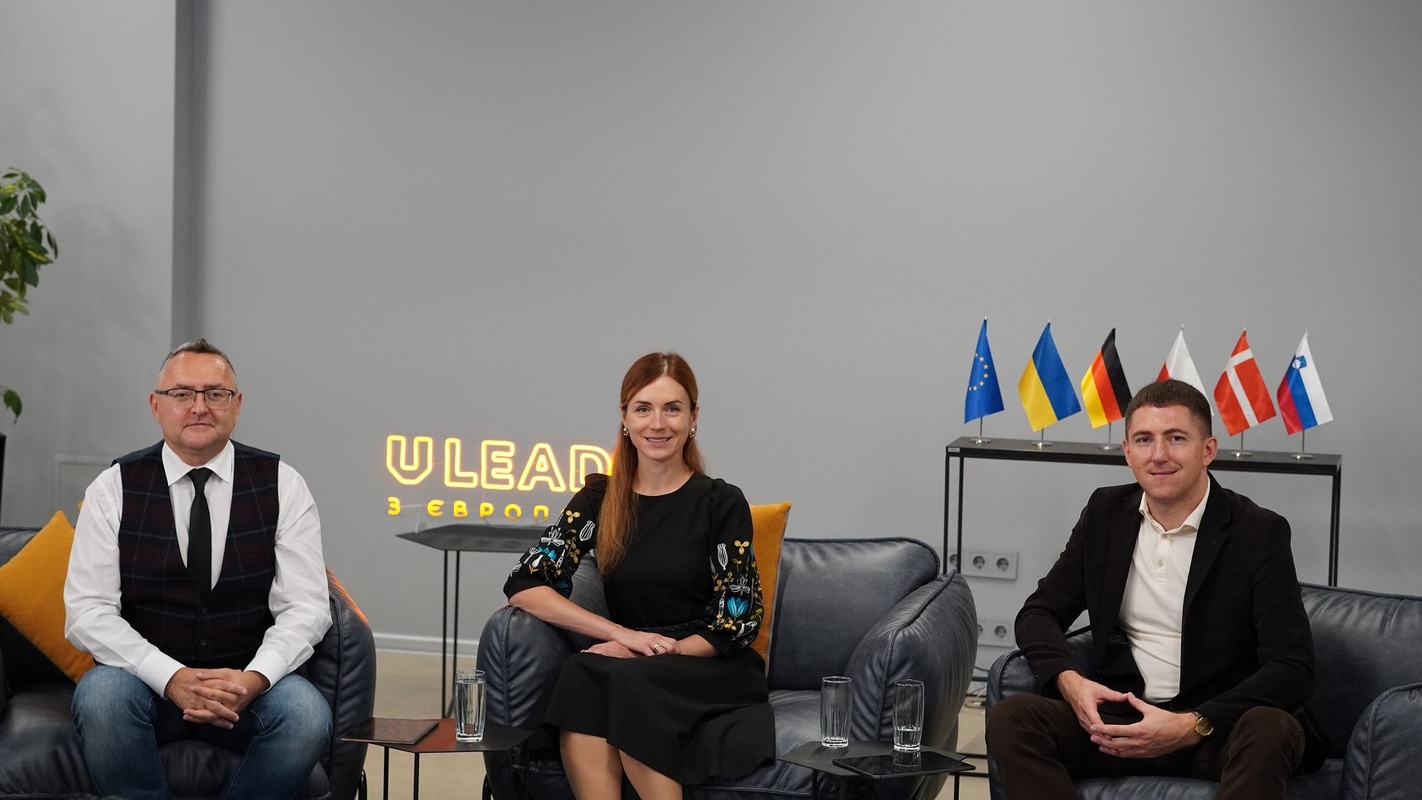



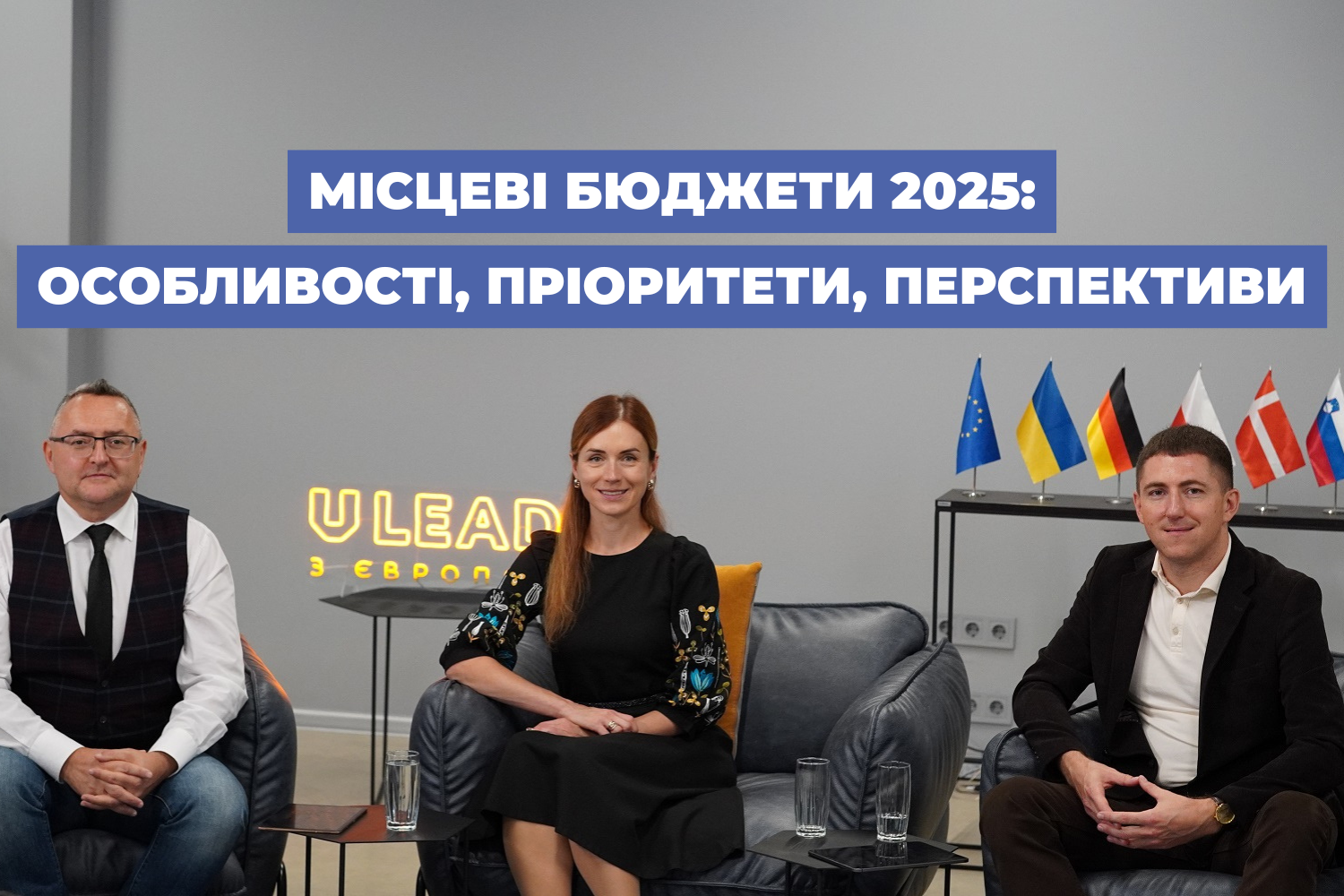
September traditionally saw the start of the specialised training programme “Steps for Specialists. Formation and Approval of the Local Budget for 2025.” At the first seminar, participants, U-LEAD experts and a representative of the Ministry of Finance of Ukraine discussed the main changes regarding the 2025 budget process.
Olena Tomniuk, Deputy Director of the U-LEAD with Europe Programme, addressed the participants of the Steps:
“The formation of the local budget is not just a technical process, filling in and fiddling with tables, digit by digit, which is then reduced to the total amount. It is, in fact, the foundation on which stability, sustainability and development of our municipalities are built. In these trying times, as we all struggle with uncertainty in our lives, the importance of strong, transparent and effective budget management is greater than ever.”
Priorities and policies of the Ministry of Finance regarding local budgets
Education, culture, health care, social protection and civil defence, territorial defence efforts and draft at the local level remain a priority for the local self-government in the 2025 budgets. This position of the Ministry of Finance was voiced by Volodymyr Yushchuk, Deputy Head of the Department of Planning of Interbudgetary Relations and Local Budgets of the Ministry of Finance of Ukraine:
“It is very difficult to balance the budget system. This is already the third budget formed in the conditions of war. Financing of the security and defence sector is therefore a priority in the Draft Law on the State Budget for 2025. And the formation of budgets requires an extremely balanced approach, because everyone understands the risks.”
The financial resource of local budgets for 2025 was adopted taking into account the Budget Declaration for 2025–2027, which was approved this year by the Resolution of the Cabinet of Ministers. This is a very important approach, as we are moving towards medium-term budget planning. Keep in mind that this was one of the demands of donors to Ukraine.
“2025 will see certain specific aspects of the formation of inter-budgetary relations in terms of horizontal equalisation. Horizontal equalisation of tax capacity for 1,331 local self-government budgets, in addition to the local self-government budgets of the occupied territories and the budgets of the cities of Kyiv and Sevastopol, will be introduced based on the expected revenues from the income tax of natural persons as per Article 64.1.1 of the Budget Code in 2024 and taking into account of the final provisions of Chapter 6.60.1 of the Final Provisions of the Budget Code,” said the representative of the Ministry of Finance.
Interbudgetary relations with 107 budgets of temporarily occupied territories are effected as an exception to Article 99 of the Budget Code in order to ensure a sufficient level of expenditures of such budgets as determined on the basis of the report on the implementation of local budgets for 2023 following general fund expenditures and taking into account the minimum wage growth index in 2024. The relevant financial resource is provided as part of an additional subsidy from the State Budget to local budgets for the exercise of powers by local self-government bodies in the de-occupied, temporarily occupied and other territories of Ukraine that have been negatively affected by the armed aggression of the Russian Federation.
According to Volodymyr Yushchuk, this approach to changing horizontal equalisation facilitated the support to subsidised municipalities that needed it.
Size matters: personal income tax, excise duty and partial return of the reverse subsidy
Nataliia Liubchenko, Adviser on Municipal Finances at U-LEAD, made several points about the sources of filling the local budget and another method of horizontal equalisation.
In 2025, the Ministry of Finance envisages the transfer of 60% of personal income tax to municipality budgets, instead of 64%, as has been the case for several years in a row. Similarly to 2024, the rule regarding the inclusion of personal income tax on the financial support for military personnel to the State budget continues to be in effect as well. For another source of revenue for the local budgets, excise duty on fuel, 13.44% of the amount of duty at the effective rate in 2025 will be allocated towards the local budgets.
“Another, shall we say, throwback to the classic model of horizontal equalisation is the return to the withdrawal of the reverse subsidy from the budgets of municipalities. In this year, such a subsidy is not withdrawn and remains in the budgets of municipalities, creating an additional financial resource for them. However, for 2025, the Ministry of Finance clearly sees the need to withdraw the reverse subsidy from local budgets and transfer it to the State Budget to be used as an equalisation resource for the remaining municipalities,” said Nataliia Liubchenko.
In 2025, this subsidy will be withdrawn in those municipalities where the income per 1 resident is more than UAH 4,458, i.e. the tax capacity index is over 1.1. Rather than the entire amount, up to 50% will be withdrawn. The withdrawal is planned for 194 local budgets.
Minimum wage and subsistence minimum
At the event, the representative of the Ministry of Finance also outlined a number of basic social standards provided for in the Draft State Budget, which are to be taken into account when drawing up local municipality budgets. For instance, this is the minimum wage at the fixed level of UAH 8,000, the subsistence minimum for children under the age of 6 at UAH 2,563, for children aged 6 to 18 at UAH 3,196, for able-bodied persons at UAH 3,028, for persons who have lost their working capacity at UAH 2,361.
In addition, the system of remuneration of local self-government employees will remain the same until the Law of Ukraine “On Service in Local Self-Government Bodies” enters into force. Bonuses for the officials of the local self-government bodies will continue to be paid in an amount not exceeding 100% of the official salary until martial law is lifted.
Three-year plans are returning, but not all at once
Another feature of the 2025 budget will be the return to medium-term budget planning. However, it will be coming back in full in stages.
“The long-awaited Law No. 11131 has been approved and signed by the President. I would like to reaffirm that there is no need to make forecasts this year. This provision enters into force on 1 January 2025. We will make forecasts for 2026–2028,” said Volodymyr Yushchuk.
As for the instructions on budget requests, the forms of budget requests, which have been unchanged this year, they are to be changed, improved and brought into line with medium-term budget planning in the future.
“This will be the result of the preparation of budget proposals. We understand that we are moving towards electronic document management. For this last year, we developed the Order on Budget Proposals, which provides for automated forms. We’d like to ensure that primary administrators follow the content of the budget proposals for the budget request forms,” said the representative of the Ministry of Finance of Ukraine.