


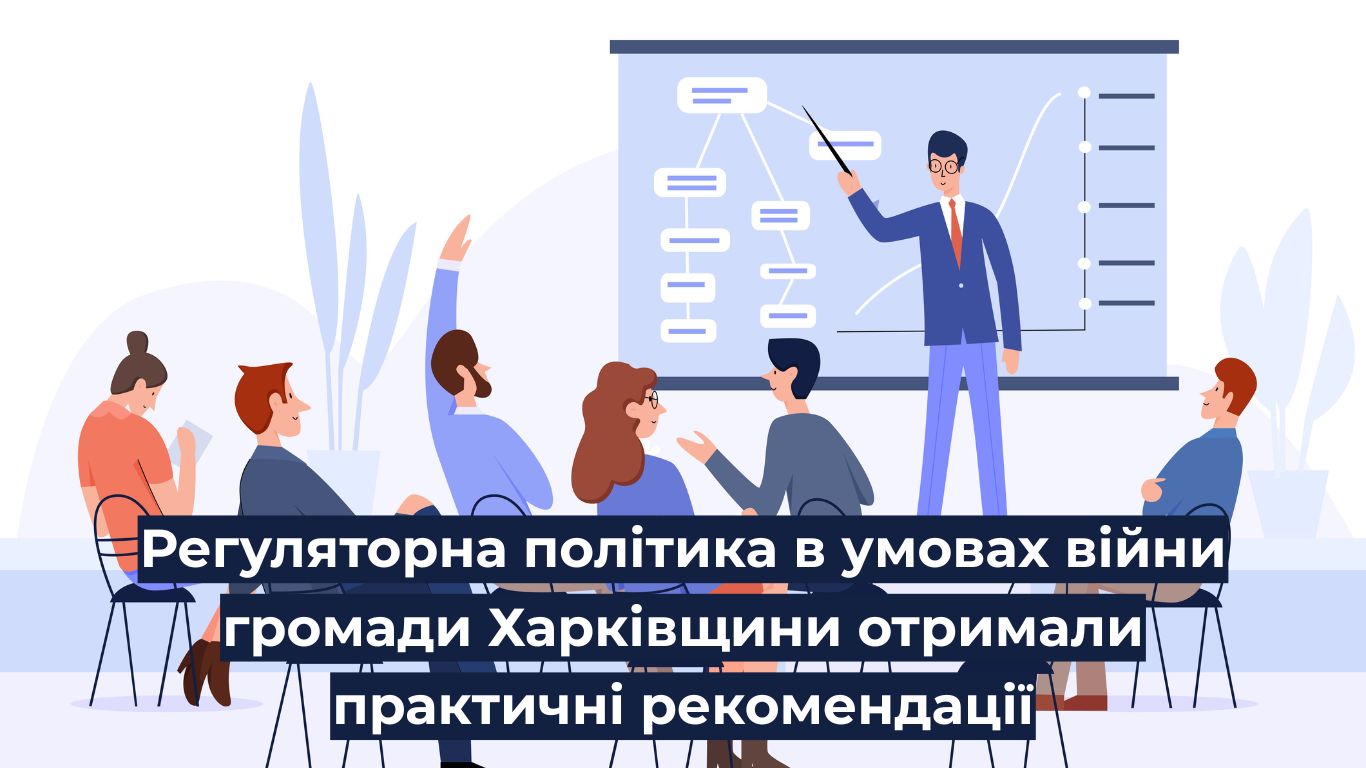
The infosession brought together heads of municipalities and their deputies, experts from the economic and financial departments, as well as other executive units. At the event, the participants learned about the legal framework of the regulatory activities of local self-governments, the key stages of this process which they analysed in detail, as well as received practical advice on the development and adoption of regulatory acts under the martial law.
"In addition to reminding municipal officials of the procedures for adopting regulatory acts, we aim to reaffirm that disregarding the regulatory activity laws can affect the performance of businesses and undermine the economic stability of municipalities in wartime, especially in front-line regions such as Kharkiv Oblast," said Maryna Honcharenko, the Head of the Regional Office of U-LEAD in Kharkiv Oblast.
The key speaker of the session was Liudmyla Haidarenko, the Chief Officer of Eastern Interregional Sector of State Regulatory Service of Ukraine.
She emphasised that in accordance with Article 10 of the Law of Ukraine "On the Legal Regime of the Martial Law’, the acts of local self-government bodies under martial law do not fall under the Law "On the Principles of State Regulatory Policy in Economic Activity". Indeed, since May 2022, local self-government bodies have been authorised to adopt regulatory acts outside the procedure prescribed by the law. However, the State Regulatory Service strongly discourages local self-government bodies from abusing this opportunity, as all acts must comply with Article 19 of the Constitution of Ukraine, i.e. be implemented strictly on the grounds, within the scope of authority and in the manner determined by law, including the Law ‘On the Principles of State Regulatory Policy in Economic Activity."
The session focused on the legal and administrative principles of implementing state regulatory policy in economic activity, including the powers of the State Regulatory Service, as well as supervision and control mechanisms. The participants closely examined the stages of regulatory activity that dictate the unified procedure for developing and adopting draft regulatory acts, requirements for their disclosure and regulatory impact assessment, as well as guidelines for their follow-up and revision.
"The session was another step towards building a constructive dialogue between local self-government and state institutions, given that this type of cooperation is what enables compliance of municipalities, including compliance with the principles of state regulatory policy in economic activity under the martial law," summarised Tetiana Filatova, the Policy Advisor for Decentralisation and Local Self-Government and moderator of the event.