





The following are top priorities for local self-government officials: taking care of and creating conditions for successful reintegration of the war veterans, their families, families of the fallen, missing, men and women defending Ukraine into municipality’s life.
This was the focus of the training programme “Implementation of a Model of War Veteran and Their Families Support in the Municipality” organised by the U-LEAD with Europe Programme. Support models proposed for implementation in the municipalities included the following: Veterans‘ Space, Single Veteran’s Window, Veterans’ Policy Department/Sector and Interagency Cooperation.
The support programme covered the entire scope of the processes – from studying the needs of the war veterans, their families, families of the fallen, missing, families of men and women defending Ukraine to choosing a support model adapted to the individual needs of every municipality. This was stated by Valeriy Mikulich, Head of the Social Well-being Task Force, Decentralisation and Local Self-Government Adviser of the U-LEAD with Europe Regional Office in Zhytomyr Oblast.
“Currently, the municipalities are doing a lot to support veterans and their families. Meanwhile, support in the municipalities often comes down to financial assistance, and the support model is ineffective or is missing at all. Therefore, during the training, the team and trainees were focused on getting familiar with the roadmap that leads step by step to choosing the best support model for the municipality – in particular, by practising the skills of preparing the necessary documents. Men and women veterans in each municipality should not feel alone.”
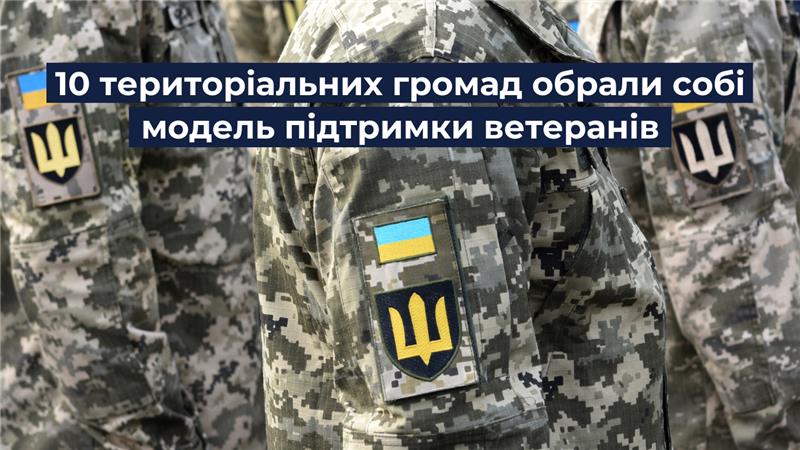
The support programme lasted for three months. Six teams of trainees chose Veterans‘ Space, two chose Interagency Cooperation, one chose Veterans’ Policy Sector as a part of the village council, and another chose Single Veteran’s Window based on the ASC. The support programme was developed by the expert team of the U-LEAD with Europe’s Social Wellbeing task force, which in addition to combining information on studying the needs of veterans, analysed the resources (human, financial, institutional, etc.) of the municipality, and applied criteria for choosing the optimal model of veterans’ support for the municipality, rather than just drafted local regulations.
Oksana Shvets, Adviser on Municipal Finance and Management at the Regional Office of U-LEAD with Europe in the Ivano-Frankivsk Oblast, said:
“Of course, we did not offer universal approaches. They may not exist at all, given the different current number of veterans, their various needs, different levels of municipalities provision with resources, and the possibility of using certain tools in every municipality. Our team presented the step-by-step algorithm for selecting a model, taught them how to master approaches to studying the needs by forming a questionnaire, analysing resources (not to give up when there are not enough resources, but to find compensators in their municipality, in neighbouring municipalities, develop the ways to get local businesses, NGOs, charitable foundations involved in this matter), and together with the trainees developed a matrix for selecting a certain support model, and compiled risk registers. As a result, every team participating in the training programme, based on the skills they had acquired, chose a support model for themselves that, on the one hand, is the most appropriate for their municipality, and on the other hand, is the most effective in terms of providing support to war veterans and their families’.
Every team of trainees also developed an action plan to support the war veterans, their families, family members of fallen (deceased) war veterans, missing in action, and men and women defending Ukraine for 2025-2027. This document outlined strategic trends of veterans’ policy in various areas of the respective territorial municipality’s activities, with the help of all possible tools.
The trainees noted that the course was extremely useful and practical, and that they would use the skills they had acquired in their future activity. The trainees saw a particular value in the opportunity to improve their professional competencies due to the high-quality materials and support of U-LEAD experts.
“It is important to keep going forward. Implementation of the support model for war veterans and their families is only the first step. Further systematic study of the needs of the target audience, regular analysis of the available resources, constant interaction with the partners, timely response to the challenges, monitoring and evaluation of the implemented support model, implementation of the planned measures to implement the veteran policy will make this support truly effective and facilitate the reintegration of veterans into the municipality”, Oksana Shvets summed up.