







Essentially, this method involves using a formula that includes the market price of electricity, the costs of its transportation and distribution, as well as the supplier’s trade margin. This approach is considered to be optimal as it reflects actual market conditions and costs as accurately as possible.
Regulatory framework
- Law of Ukraine “On Public Procurement”;
- Law of Ukraine “On the Electricity Market”;
- Resolution of the Cabinet of Ministers of Ukraine No. 1178 “On Approval of the Specific Aspects of Public Procurement of Goods, Works and Services for the Procuring Entities under the Law of Ukraine ‘On Public Procurement’ for the Duration of the Legal Regime of Martial Law in Ukraine and for Ninety Days upon the Termination or Cancellation Thereof” dated 12 October 2022;
- Resolution of the Cabinet of Ministers of Ukraine No. 822 “On Approval of the Procedure for the Creation and Operation of an Electronic Catalogue” dated 14 September 2020;
- Order of the Ministry of Economy No. 11712 “On Approval of Guidelines on the Specific Aspects of Public Procurement in the Electric Power Sector for the Duration of the Legal Regime of Martial Law in Ukraine and for Ninety Days upon the Termination or Cancellation Thereof” dated 7 May 2024.
Let us consider the calculation stages using formula pricing
Stage 1. Calculation of the expected cost of purchasing electricity
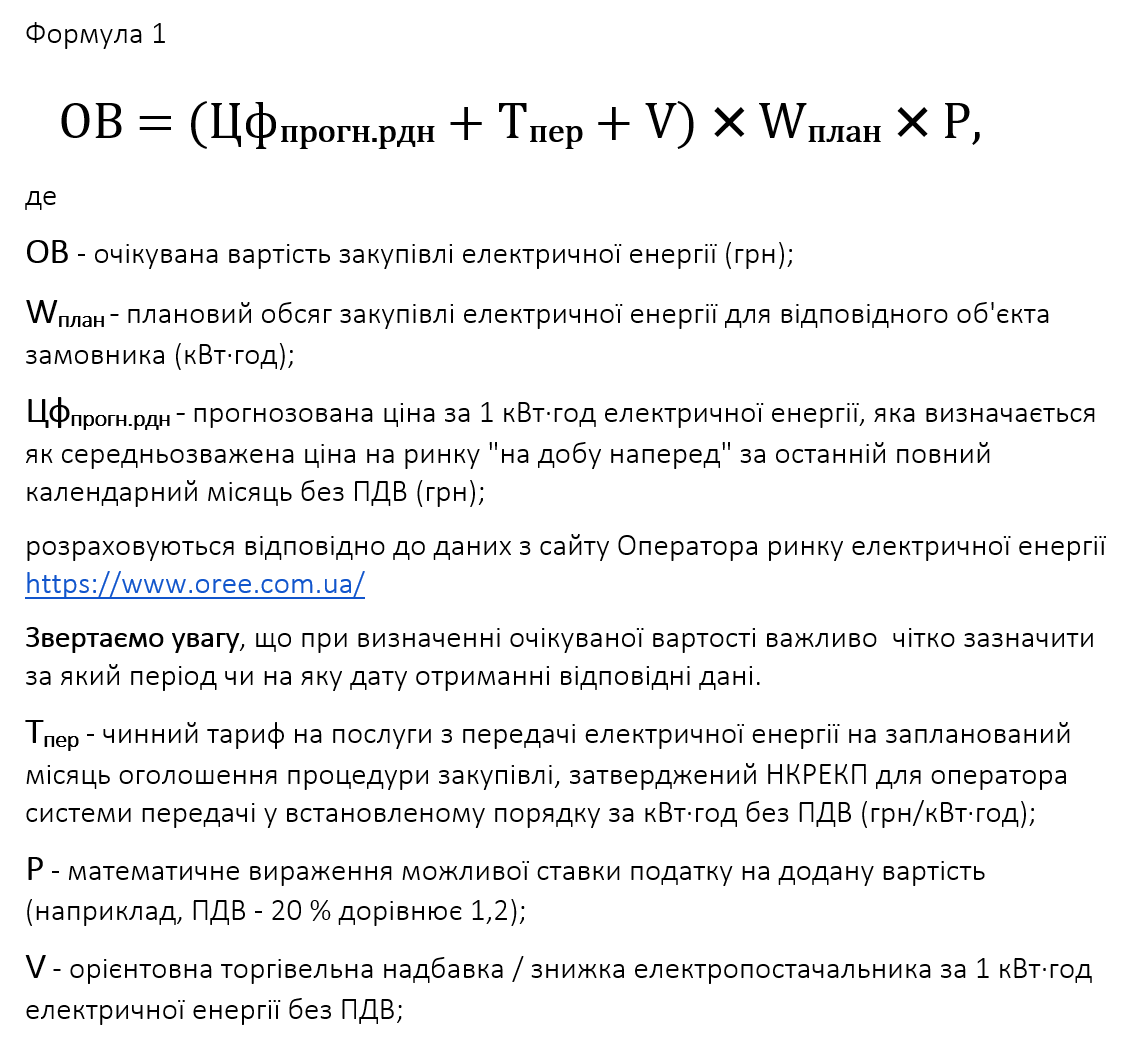
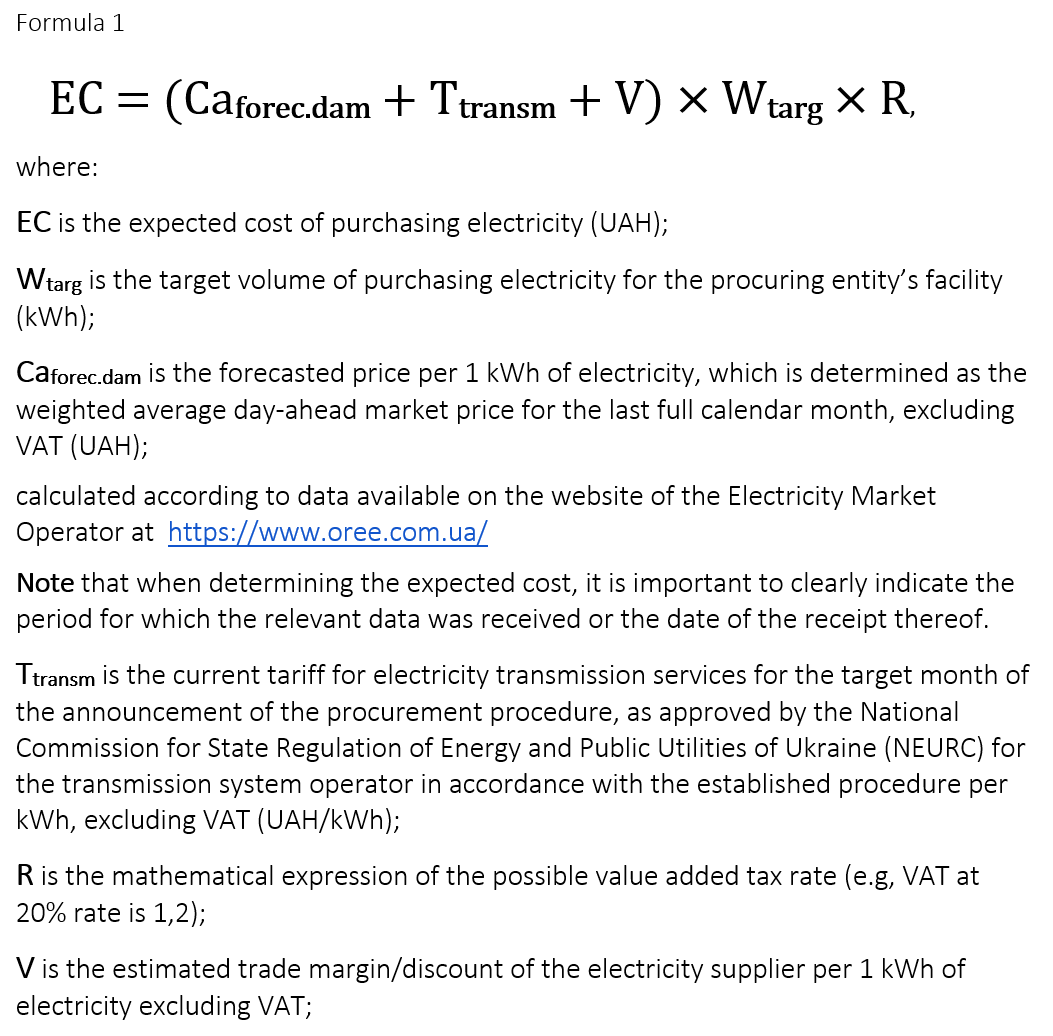
This requires accounting for basic indicators (purchase volume, forecasted day-ahead market price, electricity transmission tariff, and supplier’s trade margin or discount) and applying the Formula 1, which is shown in the gallery below.
Procuring entities should be aware that the trade margin should include the cost of the supplier’s services, including mandatory taxes, fees and payments stipulated by market rules, legislation and other regulatory documents (including, but not limited to, the NEURC regulation fee and the cost of imbalance settlement, etc.).
The Law of Ukraine “On the Electricity Market” defines electricity imbalances as the difference between the actual volumes of supply or consumption, import, export of electricity by the party responsible for the imbalance and the volumes of purchased and sold electricity. Imbalances are calculated in accordance with market rules and for each settlement period.
Depending on the difference between supply and consumption, imbalances can be either positive or negative.
According to a significant number of electricity buyers, the cost of the trade margin cannot be negative. Note, however, that, in accordance with paragraph 28 of CMU Resolution No. 1178, tender documentation must not contain requirements that set a lower limit on the quote submitted by a bidder.
As of today, there are no such restrictions when purchasing using the Request for Proposal tool.
When determining the trade margin, account for the trade margin/discount of the winning bidder, which is determined when signing the contract (is not subject to change during the term of the contract), excluding VAT (UAH)
X is the percentage of possible fluctuations in the price of electricity during the procurement procedure, given market dynamics and price fluctuations, which can be set within 10% (the percentage can be increased or decreased by the customer depending on the target volume of consumption).
When calculating possible fluctuations, factor in fluctuations in the cost of electricity according to the Electricity Market Operator at https://www.oree.com.ua/.
Calculate it as the arithmetic mean of the percentage data for fluctuations in the price of electricity for the relevant period since the beginning of the year or for the previous 12 months.
Stage 2. Calculation of the actual price
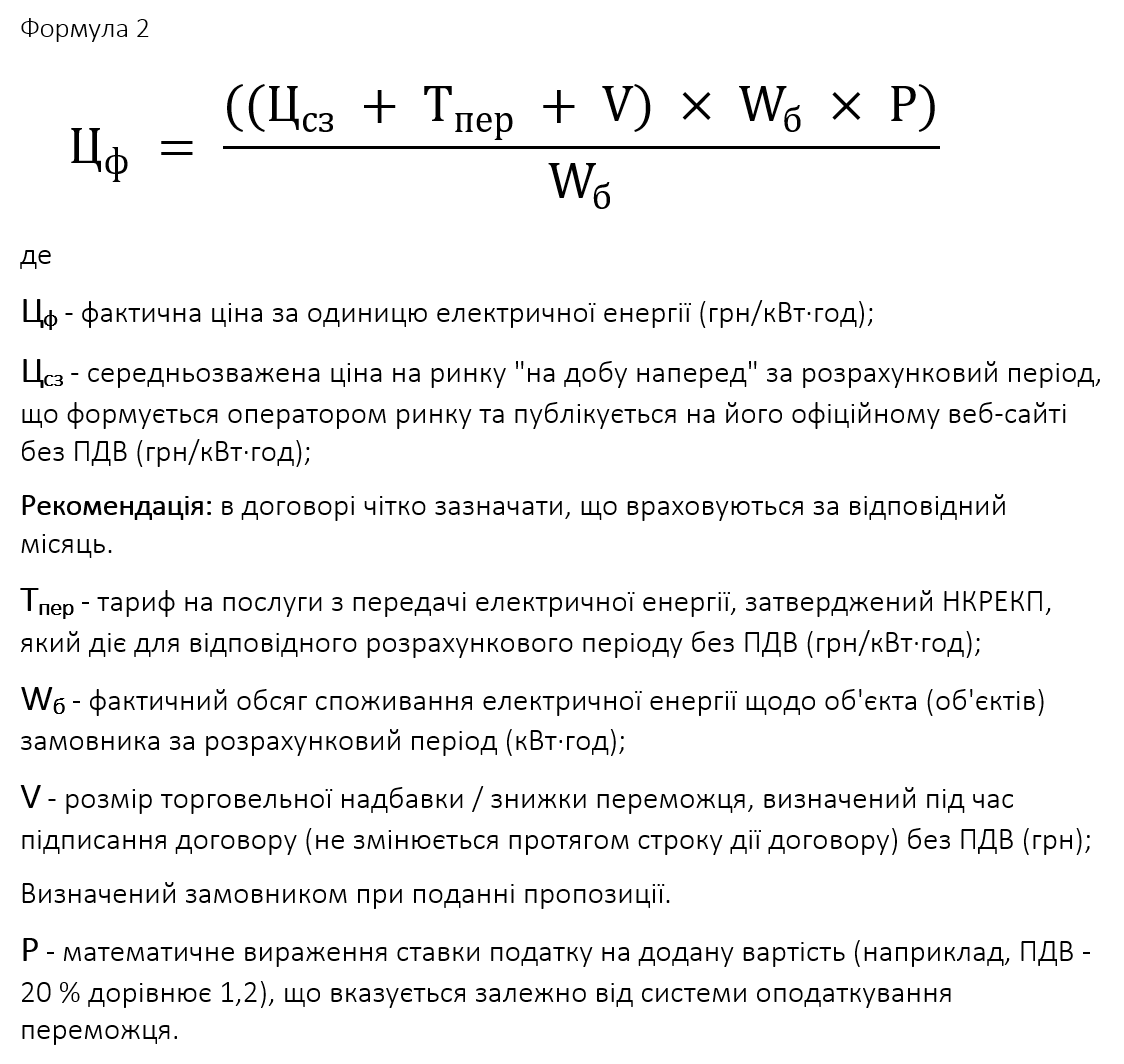
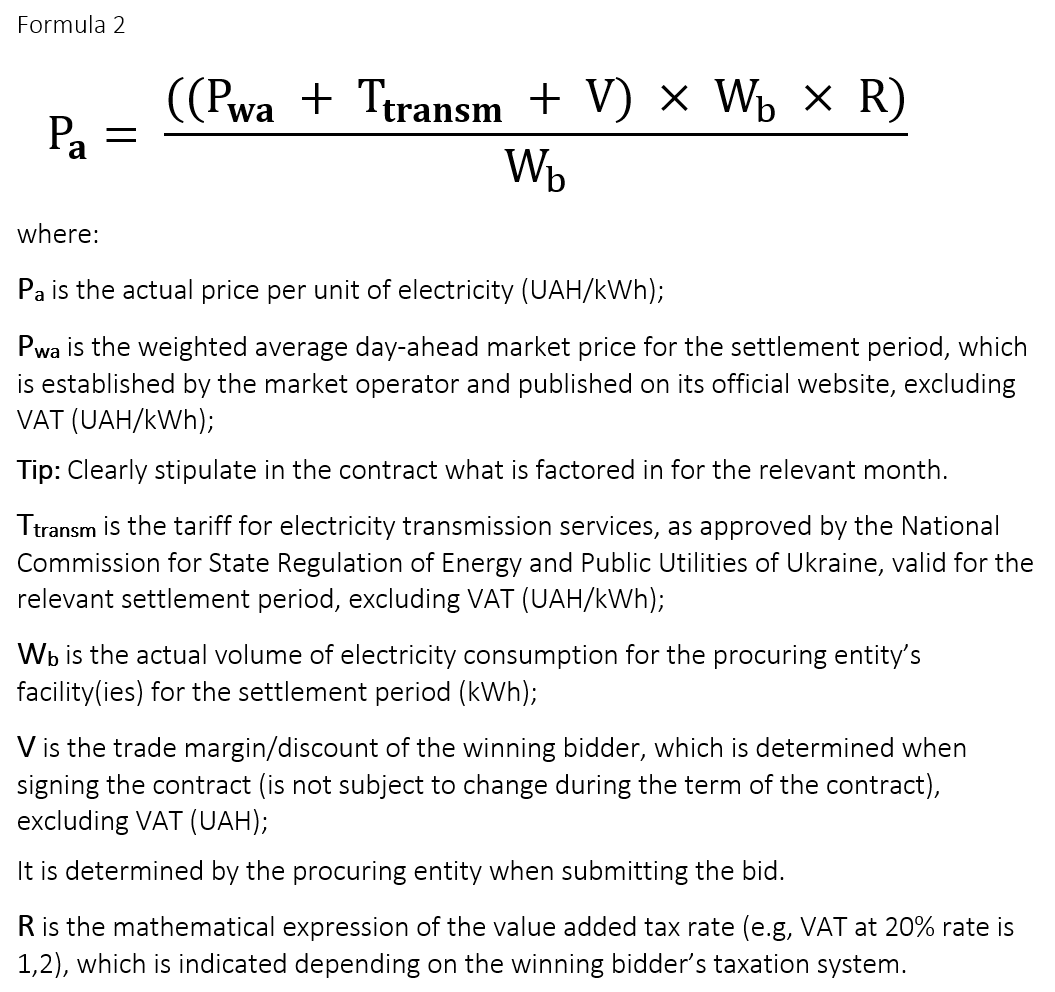
When determining the actual price per unit of electricity with VAT for a procuring entity that operates a facility, for the settlement period (excluding electricity distribution services), calculate it according to the Formula 2, which is shown in the gallery below
Using a formula calculation allows consumers to effectively manage electricity purchases and promptly respond to price changes in the market, thus ensuring transparency and compliance.
Keep in mind that the contract must clearly set forth the terms of electricity supply and the components of the formula calculation.
Therefore, formula pricing is convenient for both the consumer and the supplier, especially when market prices are constantly shifting. For the consumer, this approach has a number of advantages, such as potential for savings, transparent price adjustments and improved cooperation with suppliers.