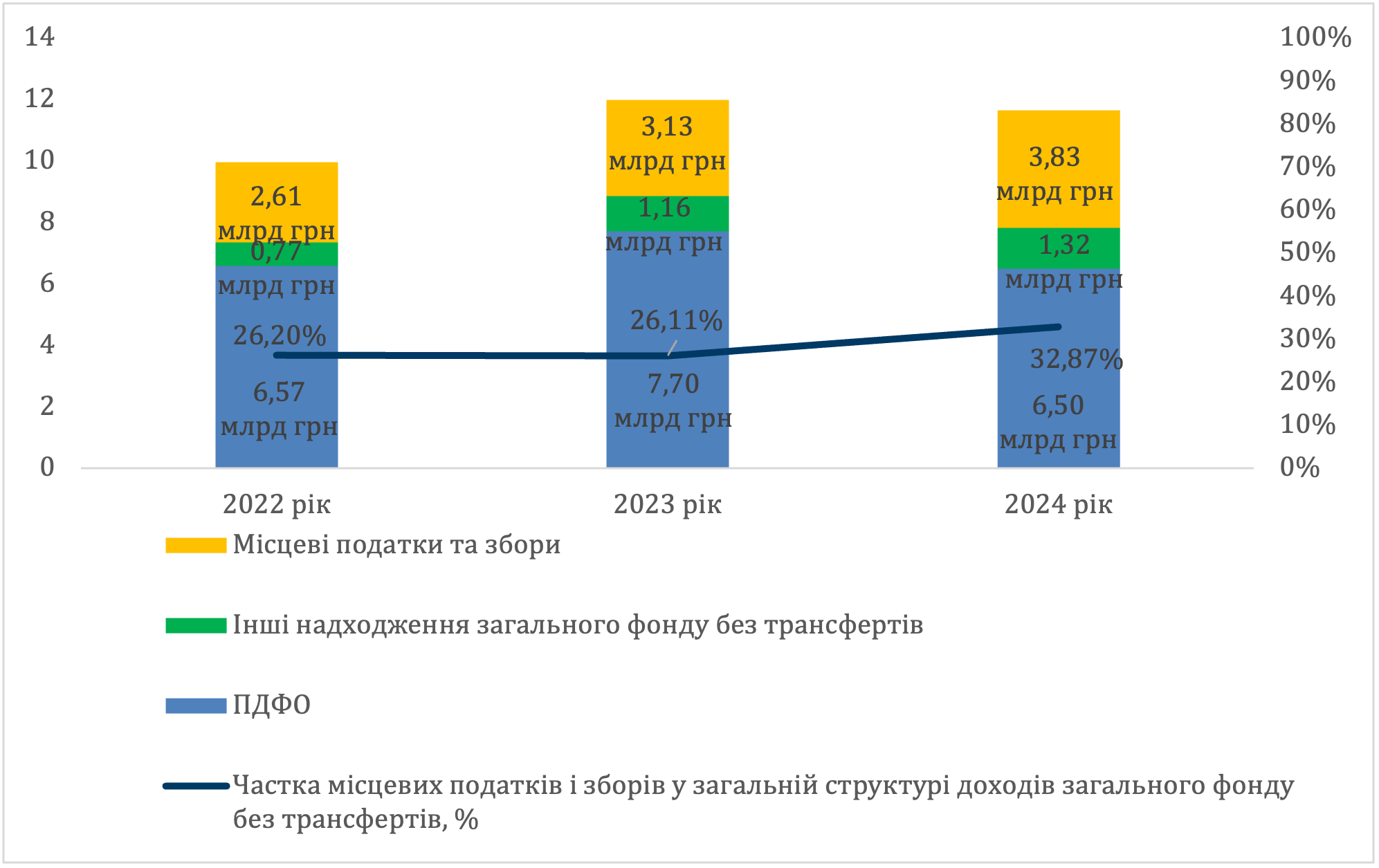








Local tax and fee revenues in Cherkasy Oblast are stable and play a big part in municipal budgets. During 2022–2024, these revenues increased by UAH 1.2 billion or +47%. Over the same period, revenues of the main account of local budgets (excluding inter-budgetary transfers) increased by UAH 1.7 billion, or +17.2%. This means that local taxes and fees grew faster than the main account revenues of municipalities (excluding transfers).
For this period, Ruska Poliana municipality showed the highest growth rate, 83.6% (UAH 19.3 million).
Dynamics of revenues from personal income tax, local taxes and fees as well as other main account revenues (without transfers) - see the infographic in the gallery below.
During 2022–2024, the average share of local taxes and fees in main account revenues without transfers in municipalities of Cherkasy Oblast was 28.5%. This share amounted to about 26.1% in 2022 and 2023 and 32.9% in 2024. Thus, the share of local taxes during this period increased by 6.8 percentage points. This indicates that local taxes and fees are playing a bigger role in local budget revenues.
The largest share of local taxes in main account revenues was in Lypianka municipality (60.45% in 2022; 59.49% in 2023; 60.01% in 2024). The lowest share was in the municipalities of Stepanky (8.65% in 2022), Korsun-Shevchenkivskyi (7.32% in 2023) and Stepantsi (9.16% in 2024).
Composition of local taxes and fees in 2022–2024
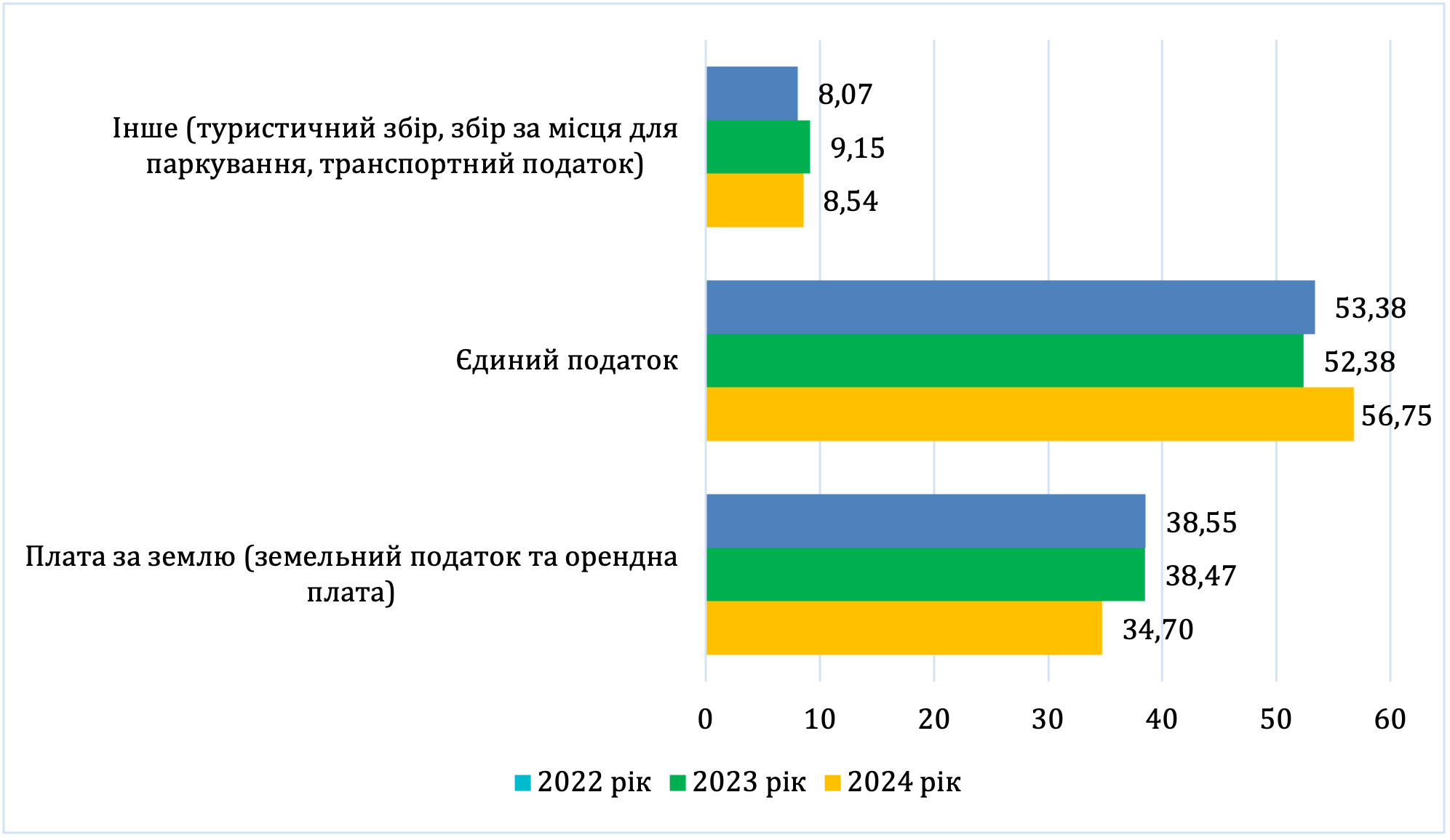
The largest share in local taxes’ breakdown is taken up by:
- single tax: 53.4% in 2022; 52.4% in 2023; 56.8% in 2024
- land fee: 38.6% in 2022; 38.5% in 2023; 34.7% in 2024
These two sources constitute the bulk of municipalities’ own revenues.
In 2022–2024:
- revenues from the single tax increased by UAH 0.8 billion (+56.3%)
- revenues from fees increased by UAH 0.3 billion (+32.3%)
Composition of local taxes and fees in 2022–2024 - see the infographic in the gallery below.
In 2023, tax breaks for small businesses were discontinued. Furthermore, businesses in the region have adapted to the wartime conditions. In addition, starting from Q4 2023, the “military” portion of personal income tax has been transferred to the state budget.
These factors contributed to a change in the tax revenue composition and increased the relative share of local taxes and fees in municipal budgets.